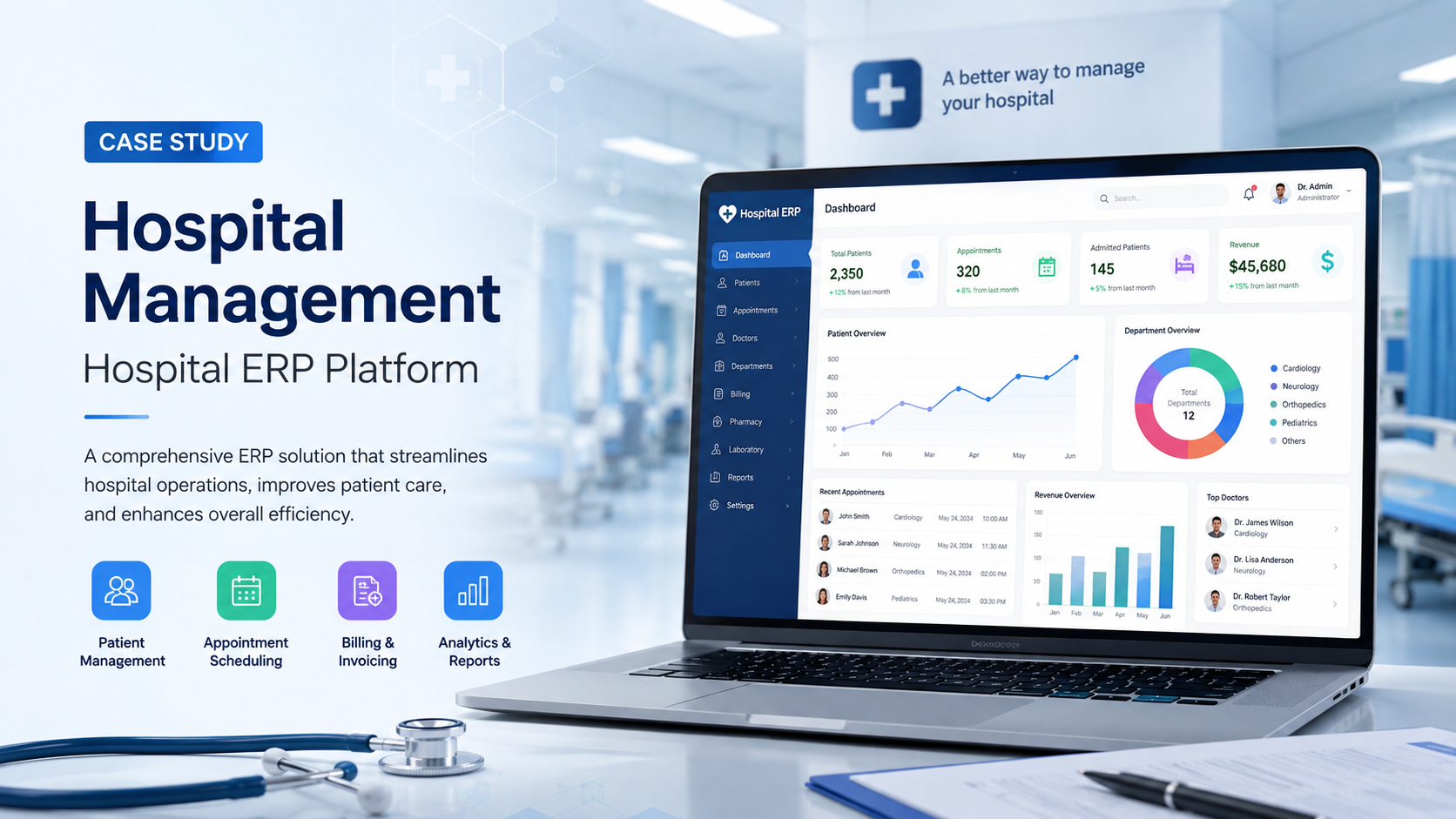
Managing a hospital involves much more than treating patients. From appointment scheduling and patient registration to doctor management, billing, pharmacy, laboratory reports, and day-to-day administration, there are many processes happening at the same time.
Our goal was to create a Hospital Management System that brings these activities together in one centralized platform.
The system was designed to help hospitals reduce manual work, improve coordination between departments, and give doctors, staff, and administrators easier access to the information they need.
The Challenge
The hospital was handling many of its daily operations through separate systems and manual processes.
Patient information had to be managed carefully across different departments. Appointment scheduling could become difficult during busy hours, while staff needed a better way to manage doctor availability, billing records, laboratory reports, and other important information.
The main challenge was to create a system that could connect different departments without making the software complicated for hospital staff.
The platform needed to be simple enough for everyday use while still being flexible enough to support the growing needs of the hospital.
Our Approach
We started by understanding how different departments work and how information moves from one stage to another.
For example, a patient's journey may begin with registration, followed by an appointment with a doctor. Depending on the consultation, the patient may require laboratory tests, medicines, admission, billing, or follow-up appointments.
Instead of treating each department as a completely separate system, we designed the platform to keep the relevant information connected.
This helped create a smoother workflow and reduced the need for staff to repeatedly enter the same information.
The Solution
We developed a centralized Hospital Management System that allows hospital administrators and staff to manage important operations from a single platform.
The solution included separate modules for different users and departments, ensuring that each person could access the tools and information relevant to their role.
The platform was designed to support both administrative and operational requirements while keeping the overall user experience simple and easy to understand.
Key Features
Patient Management
The system allows staff to register and manage patient information in one place.
Key functionality includes:
- Patient registration
- Patient profiles
- Medical history management
- Visit records
- Follow-up information
- Patient search and record management
Doctor Management
Doctors and administrators can manage doctor-related information and availability.
Features include:
- Doctor profiles
- Department and specialization management
- Availability management
- Appointment schedules
- Patient consultation records
Appointment Management
The appointment module helps organize patient bookings and doctor schedules.
It includes:
- Online and offline appointment booking
- Appointment scheduling
- Doctor availability
- Appointment status management
- Follow-up appointments
- Appointment notifications
Billing and Payments
The system provides a centralized way to manage hospital billing activities.
Features include:
- Patient billing
- Service charges
- Payment records
- Invoice generation
- Pending payment tracking
- Billing reports
Laboratory Management
The laboratory module helps manage test requests and reports.
Key functionality includes:
- Test management
- Laboratory requests
- Report management
- Patient test history
- Report status tracking
Pharmacy Management
The pharmacy module helps manage medicines and related transactions.
Features include:
- Medicine management
- Stock monitoring
- Medicine sales
- Prescription-based records
- Inventory tracking
Administration and Reporting
The admin panel gives management better visibility into hospital operations.
It includes:
- Role-based access
- Department management
- User management
- Operational reports
- Patient reports
- Appointment reports
- Billing reports
- Dashboard analytics
Technology
The platform was built using modern web technologies to ensure that it remains scalable and maintainable.
Backend: Laravel / PHP
Frontend: Responsive Web Interface
Database: MySQL
Architecture: REST API-based architecture
Security: Role-based access control
Deployment: Cloud-ready infrastructure
Challenges We Solved
One of the most important challenges was connecting different hospital workflows while keeping the system easy to use.
A hospital has multiple departments, and each department works differently. Doctors need access to patient and appointment information, while administrative staff may need billing and registration tools.
We addressed this by implementing role-based access, allowing users to access only the modules and information relevant to their responsibilities.
Another challenge was reducing duplicate data entry. By connecting patient records across different modules, the system helped minimize repetitive work and made important information easier to access.
Business Impact
The Hospital Management System helped create a more organized and connected operational environment.
The platform enabled the hospital to:
- Reduce dependency on manual processes
- Centralize patient information
- Improve appointment management
- Simplify coordination between departments
- Improve access to important records
- Reduce repetitive data entry
- Streamline billing and administrative workflows
- Improve operational visibility for management
The Result
The final solution provided the hospital with a centralized digital platform for managing its day-to-day operations.
Instead of relying on disconnected processes and multiple sources of information, staff could work through a more structured and organized system.
The platform was also designed with future growth in mind, allowing additional modules and integrations to be introduced as the hospital's requirements evolve.
Looking Ahead
A Hospital Management System should grow with the organization using it.
The platform can be further expanded with features such as:
- Patient mobile application
- Online doctor consultation
- WhatsApp and SMS notifications
- Online payments
- Electronic medical records
- Advanced analytics
- Insurance integrations
- Multi-branch hospital management
At Kodesoft Technologies, we help healthcare organizations transform complex processes into practical digital solutions that are easier to manage and ready to grow.